
One constant in the world of aerospace and defense connectors is the sheer variety of standards that engineers are expected to navigate, along with their associated revisions, derivatives, and cross-references. From the familiar MIL-C-38999 and MIL-C-26482 to customer-defined standards such as BACC45 and BACC63, the list can feel endless.1 This is even more challenging as engineers only encounter these connectors during new design cycles rather than working with them every day.
The connector market becomes more complex because many of these standards either overlap, reference each other, or have evolved from earlier specifications over decades of military and aerospace development. Two such specifications are MIL-C-83723 and MIL-C-26500. Many legacy designs continue to use the older standard, so engineers must be aware of the relationship between them.
MIL-C-83723 has not replaced MIL-C-26500 with an entirely new connector. For engineers already familiar with MIL-C-26500, the transition to MIL-C-83723 is far less disruptive than new specification numbers might initially suggest.
MIL-C-26500 Legacy: Origins and Continued Relevance
The MIL-C-26500 standard established a widely used series of circular connectors intended for demanding military and aerospace environments. The specification became deeply embedded in applications requiring resistance to vibration, environmental exposure, and long-term reliability.
Over time, the connector family also became associated with several derivative and related standards, including Boeing’s BACC45 and later BACC63 specifications. With such a long industrial heritage, it should be unsurprising that engineers continue to encounter MIL-C-26500 connectors across active aerospace programs today.
An engineer maintaining an older aerospace platform may still encounter MIL-C-26500 throughout existing documentation and approved parts lists. Meanwhile, an engineer qualifying hardware for a newer defense program may be required to specify MIL-C-83723 instead.
Key MIL-C-83723 Improvements Over MIL-C-26500
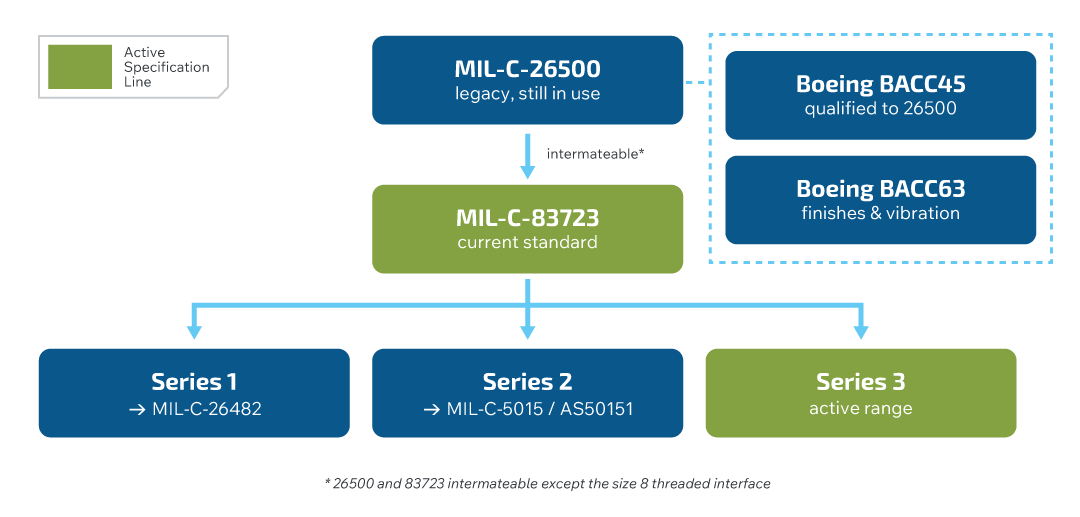
The MIL-C-83723 standard introduced a broader range of qualified configurations and environmental options, along with more detailed performance requirements. It also includes specialty options for increasingly demanding aerospace applications. The two standards remain intermateable across almost all configurations. For engineers who need to keep existing equipment operational, intermateability is perhaps the most important feature of these two standards.
Existing systems designed around MIL-C-26500 are therefore compatible with the newer standard. In most cases, the common insert layouts and shared connector geometry ensure compatibility between MIL-C-83723 and MIL-C-26500 connectors.2
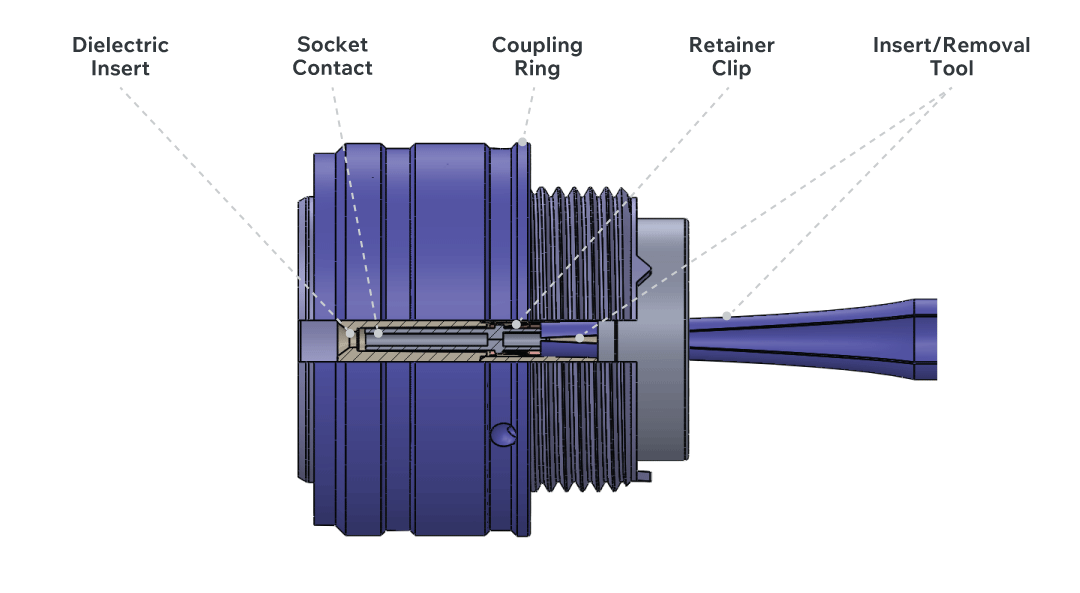
MIL-C-83723 also introduced meaningful specification-level improvements and refinements. One practical difference between the two standards is contact retention design. MIL-C-26500 connectors use front-release contacts, while MIL-C-83723 transitioned to rear-release contacts. Rear-release contact systems are widely adopted across modern circular connectors because they simplify maintenance and increase contact retention reliability in high-vibration environments. This change improves maintainability and aligns with other connector standards including 38999 and 26482.
| Feature | MIL-C-26500 | MIL-C-83723 |
|---|---|---|
| Contact release type | Front-release | Rear-release |
| Maintenance ease | Standard | Increased reliability |
| Vibration retention | Standard | Rear-release |
| Alignment with other standards | Diverges from MIL-C-38999 / 26482 | Aligns with MIL-C-38999 and 26482 |
How to Navigate the MIL-C-83723 Series Structure
Some confusion surrounding MIL-C-83723 may arise from the specification’s internal series structure. MIL-C-83723 is divided into Series 1, Series 2, and Series 3 configurations. However, not all of those series remain active within the same ecosystem today.
Series 1 was ultimately superseded by MIL-C-26482, while Series 2 was replaced by MIL-C-5015. Series 3 remains the primary active specification associated with MIL-C-83723 and covers the threaded and bayonet coupling interfaces that most engineers encounter when working with this connector range. This complexity reflects the way military connector standards have developed as different application requirements emerged across aerospace and defense programs.
MIL-C-83723 Capabilities: Beyond a Simple Renumbering
One misconception surrounding MIL-C-83723 is that it is simply a renamed version of MIL-C-26500. The newer specification introduced broader capabilities and configuration flexibility for modern aerospace environments. MIL-C-83723 supports a wider range of housing materials and finishes, including stainless steel and aluminum in anodized and nickel-plated options. Standard military finishes such as olive drab cadmium plating are still available for applications that require established military environmental protection characteristics.
MIL-C-83723 also encompasses specialty variants designed for more demanding operational requirements, including:
- Hermetically sealed configurations - retain pressure differentials across interfaces; critical for altitude and vacuum applications.
- Firewall-rated connectors - withstand extremely high temperatures; used in aero-engine zones to protect instrumentation from heat.
- High-vibration variants - remain secure under the shock and vibration of armored vehicles, catapult launches, and arrested landings.
Environmental Performance and Application Considerations
MIL-C-83723 connectors are commonly deployed on aircraft, missile systems, and other aerospace platforms where reliability under severe environmental stress is essential. Salt spray resistance, vibration tolerance, temperature resilience, and secure mechanical coupling are all vital elements of the design environment surrounding this connector family.
Compared to some smaller circular platforms such as MIL-C-38999, the MIL-C-83723 connector generally occupies a physically larger format. Despite the almost overwhelming trend towards miniaturization, the larger shell size of these connectors makes sense in demanding conditions. Larger shells offer greater mechanical robustness and improved environmental sealing, allowing these standards to prioritize ruggedness and environmental resilience over ever-more compact design.
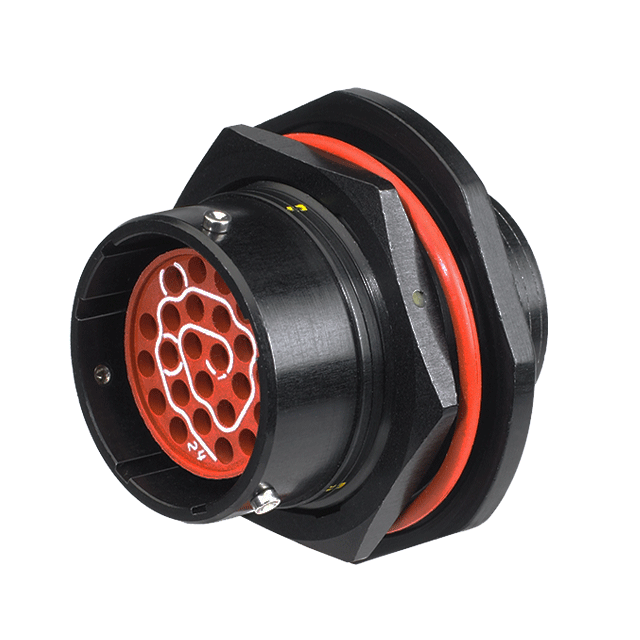
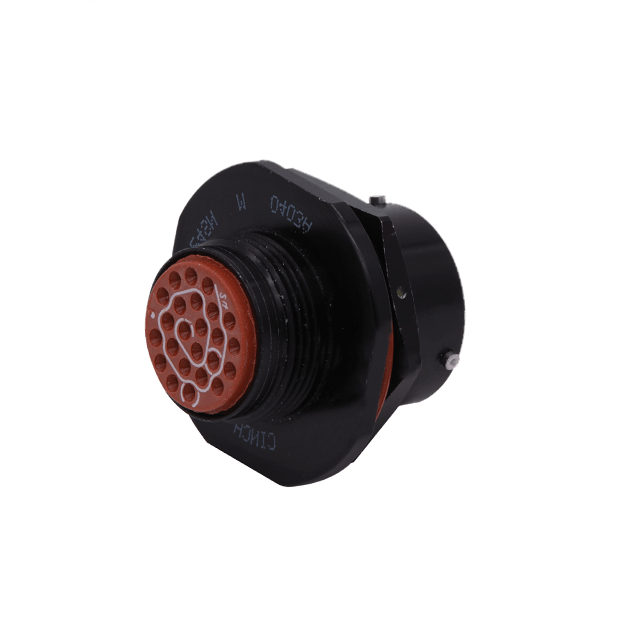
MIL-C-83723 expands available environmental and configuration options while retaining the established connector form factor. Engineers familiar with MIL-C-26500 can benefit from a platform with a wider range of qualified materials, finishes, and environmental capabilities.
MIL-C-26500 and Boeing BACC Connector Specifications
Boeing’s BACC45 and BACC63 connector specifications are both tied closely to the MIL-C-26500 family. BACC45 is effectively qualified to the 26500 standard, while BACC63 expanded the options further through additional finishes and enhanced vibration-capable configurations introduced during the early 1990s. The worldwide adoption of Boeing aircraft, and the impact their design has had on the aerospace industry globally, makes this familiarity important.
Aerospace programs depend heavily on long-term component availability, common qualifications, and proven environmental performance. The Boeing-developed specifications reinforce its enduring industrial relevance. For engineers concerned that MIL-C-26500 has somehow become obsolete or unsupported, current usage remains strong because it continues to provide a qualified interconnect solution for harsh environments.
MIL-C-83723 Connector Applications in Aerospace & Defense
As we have seen, MIL-C-83723 connectors are typically associated with applications where environmental resilience and mechanical reliability are critical.
Military aircraft remain one of the primary deployment environments. High vibration levels, wide temperature ranges, altitude exposure, and demanding maintenance cycles all place significant stress on interconnect systems. Connectors used in these environments must maintain reliable electrical performance while resisting mechanical loosening, corrosion, and environmental ingress.
Missile and munitions systems present similar challenges. Long storage periods, severe vibration exposure, and mission-critical reliability requirements make connector performance particularly important.
Long-Term Support: Why MIL-C-83723 Continuity Matters
One of the biggest challenges in aerospace and defense engineering is ensuring equipment remains effective and operational for decades. The documentation required to ensure this must be consistent across generations of programs. Engineers cannot redesign systems from scratch every time a specification evolves, and so the relationship between MIL-C-26500 and MIL-C-83723 eases that transition.
MIL-C-83723 allows engineers across the aerospace, defense, and rugged industrial markets to support systems during decades of operational service. Cinch Connectivity Solutions manufactures MIL-C-83723 Series 3 connectors in threaded and bayonet coupling configurations to support the requirements of a range of aerospace and defense platforms.
Technical Notes:
- While these standards are more properly noted as MIL-DTL-XXXXX, many engineers continue to refer to them as MIL-C-XXXXX. For this article, we will retain that notation in the text.
- The size 8 threaded interface is a known exception and is not intermateable between MIL-C-26500 and MIL-C-83723 configurations.
 Omega Circular Connectors
 Designed for Defense
 MD801 Series