
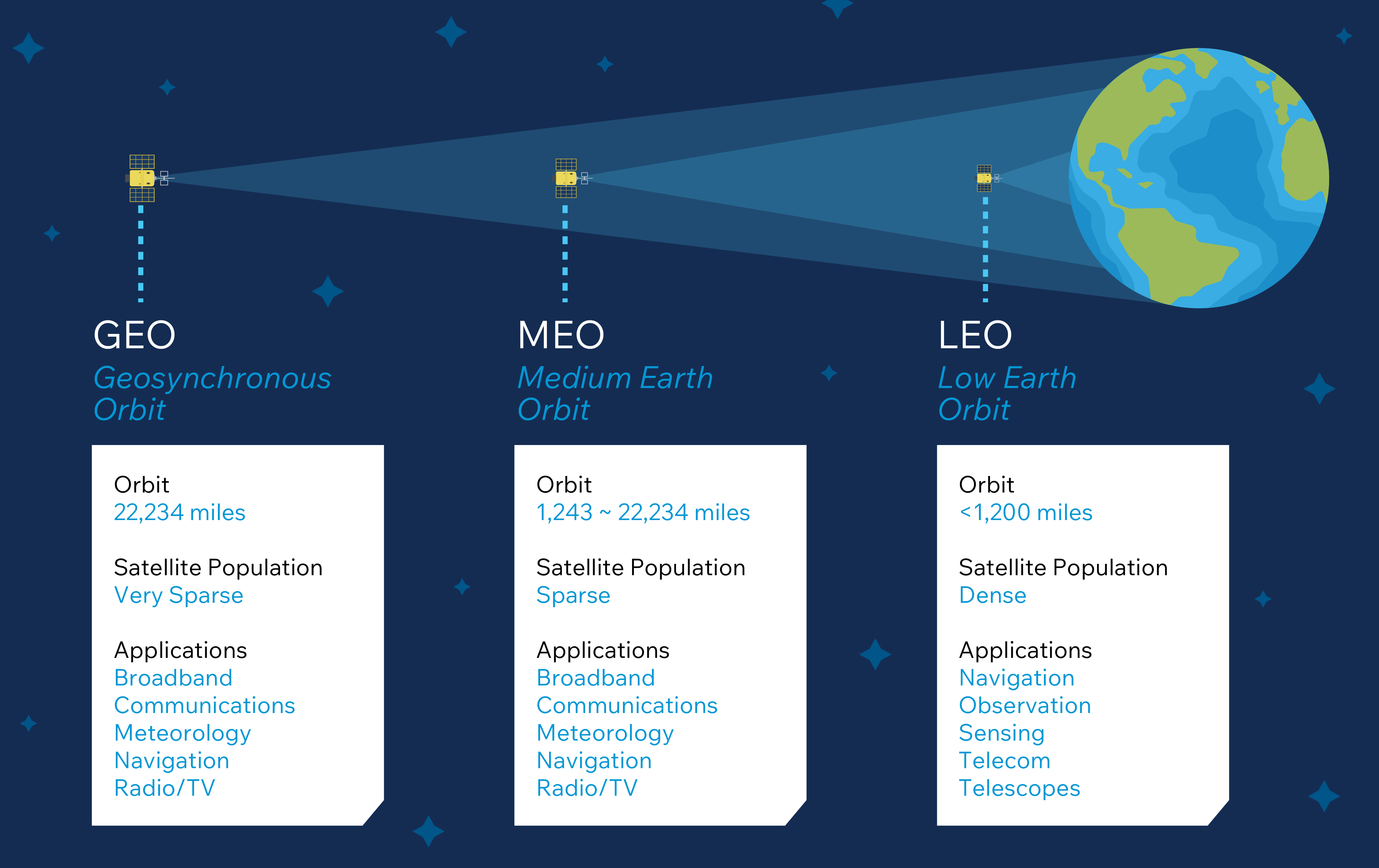
The satellite industry is moving faster than the ground infrastructure built to support it. Over the past five years, the number of active satellites in orbit has grown at a pace few predicted, driven largely by Low Earth Orbit (LEO) constellations from companies like SpaceX and Blue Origin. Every new satellite adds another link that has to be tracked, connected, and fed data, and the Radio Frequency (RF) ground stations built to do that job are starting to strain under the load.
Optical vs. RF Ground Stations: Why Optical Is Joining Radio
Optical Ground Stations (OGS) are emerging as the next step in satellite communications, but not as an overnight replacement for radio. In the near term, most new sites will be hybrids that add optical links alongside preexisting radio links. By bringing optical technology into the ground station, these designs offer a new way to move data between satellites and the ground. Within these hybrid stations, optical technology contributes several distinct advantages.
Reduced Size, Weight, and Power (SWaP)
Optical terminals can transmit more data while requiring less onboard power and less equipment mass than comparable RF systems. Because every gram and watt on a satellite is carefully budgeted, these savings can be reallocated to additional payload or capability.
Narrow-Beam Security
An RF signal spreads as it travels, which makes it easier to detect and to disrupt from well outside its intended path. A laser beam, by contrast, remains tightly focused. Intercepting or jamming an optical link requires being almost directly in line with the beam, which makes optical links inherently more secure.
Higher Bandwidth for LEO and Earth Observation Data
Modern LEO and Earth observation constellations generate substantial data volumes, and optical links can carry significantly more of that data per pass than RF links. Optical technology also avoids much of the competition for increasingly crowded RF spectrum.
The Continuing Role of RF Technology
These advantages do not make RF technology obsolete. RF systems are mature, well understood, and less affected by the weather conditions that can interrupt an optical link. This complementary relationship is the primary reason the market is currently prioritizing hybrid stations.
Optical Ground Station Applications: Commercial, Defense, and Deep Space
These advantages are already shaping where optical ground station technology is deployed, with commercial space accounting for the majority of current demand.
Commercial Space and LEO Constellations
LEO constellations represent the strongest near-term demand for hybrid ground stations. Earth observation and broadband operators manage large fleets that generate data faster than RF downlinks can efficiently transmit it. For these operators, optical technology provides a means of moving more data from each satellite during each pass while using smaller and lighter hardware.
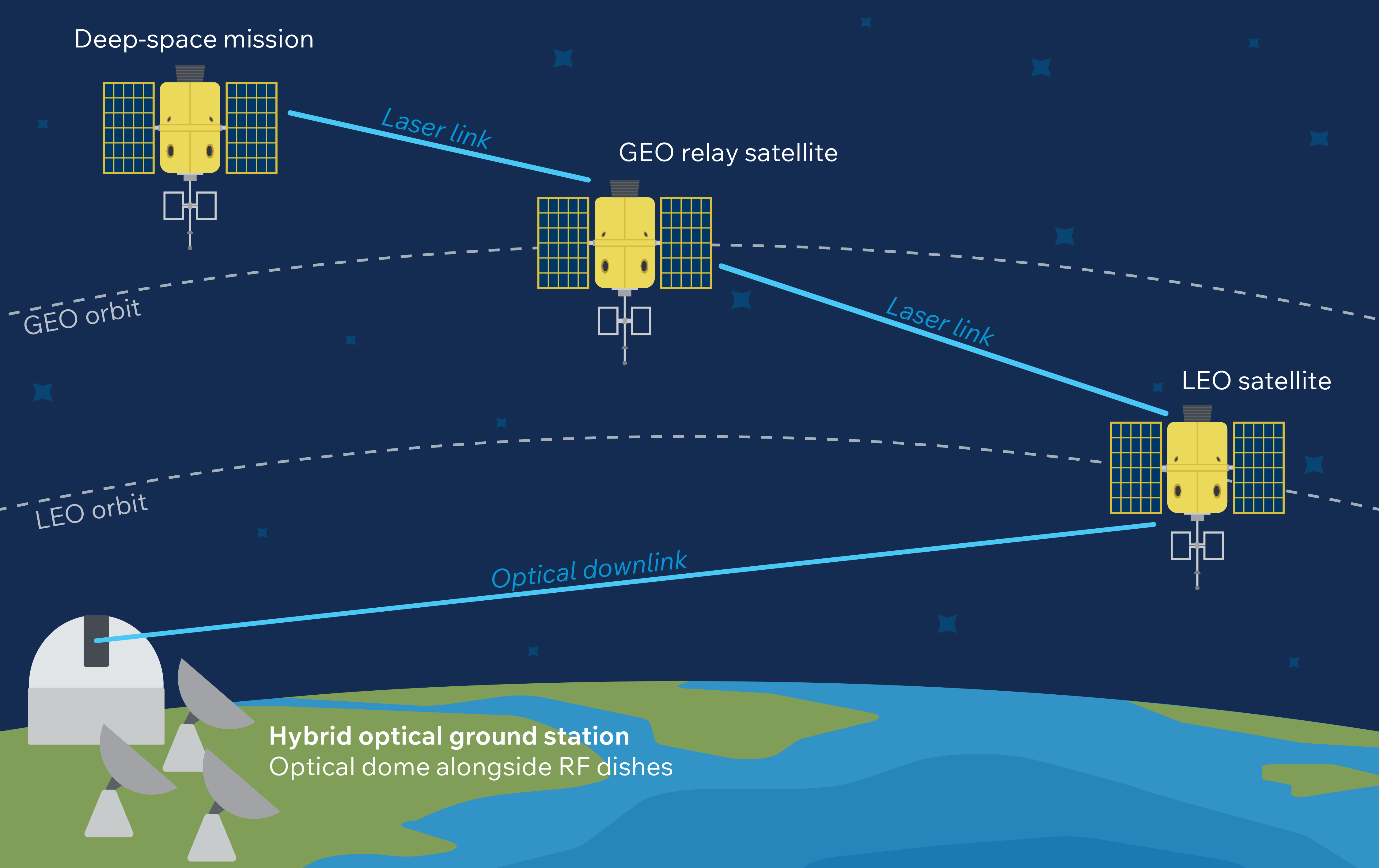
Defense and Intelligence: GEO Relay Services
A longer-term opportunity exists in geostationary (GEO) relay services built around optical transponders. The demand case is well defined: defense, security, and intelligence agencies operate both LEO and GEO satellites and transfer large volumes of data between those satellites and the ground. For these agencies, the added security of using both beams is a strong draw. These programs will take longer to mature than commercial deployments, but they represent a high-value segment of the market.
Deep-Space Optical Communications
Optical links are also valuable to NASA, whose Deep Space Optical Communications (DSOC) program has already demonstrated laser links from deep space. While this program provides an important demonstration of optical capability, deep-space communications remain a comparatively small use case.
Satellite Integrators and Satellite-to-Satellite Links
Satellite integrators are also relevant to ground station design. Although they do not build the ground station, their satellite terminals must communicate with it, which requires ground and space designs to be compatible.
Inside an Optical Ground Station: Key Subsystems and Components
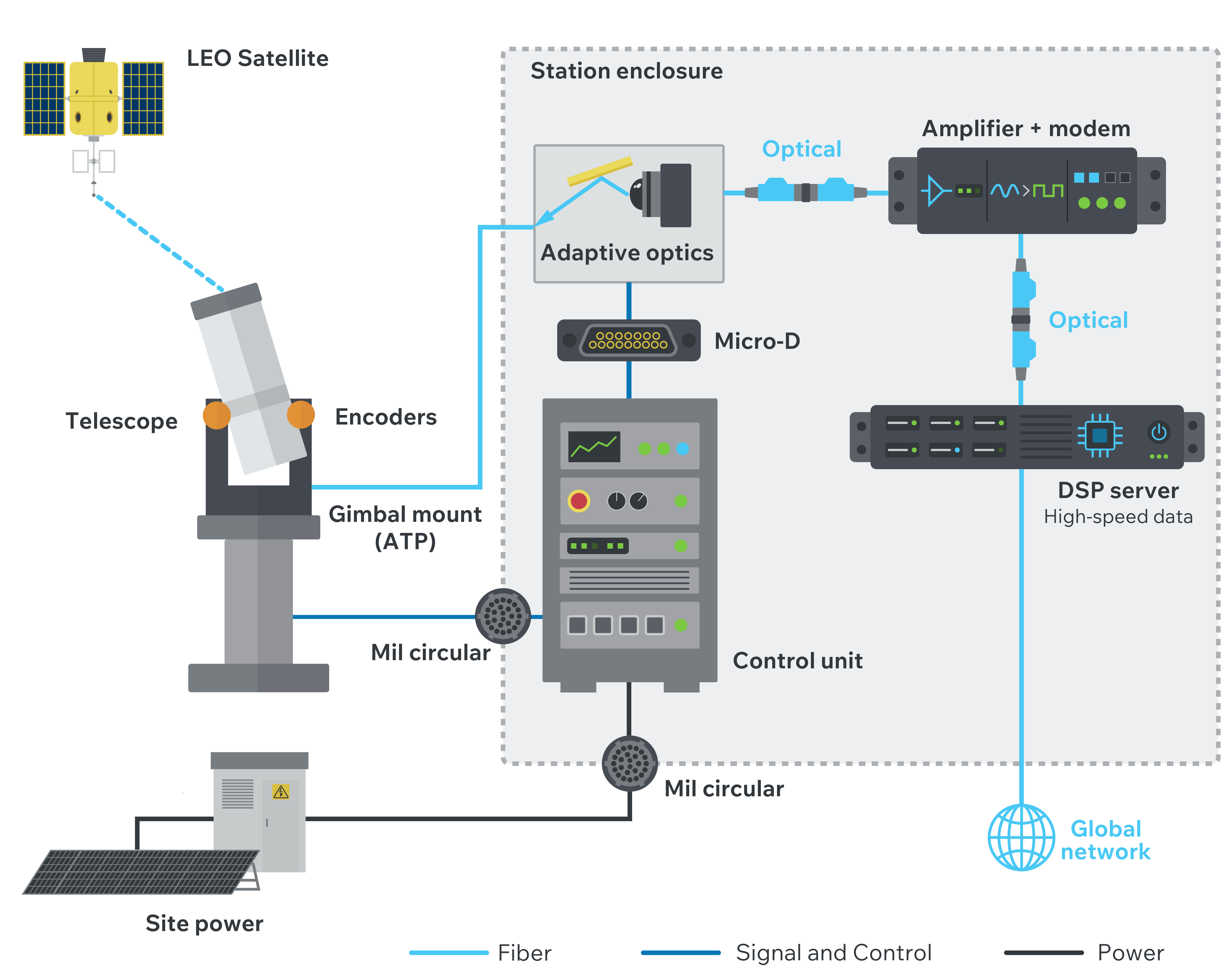
An optical ground station differs substantially from a conventional RF dish. Although it is more complex than an RF station, the enabling technology already exists and continues to mature. Each of the subsystems below is integral to the design, and each must be connected.
Optical Ground Station Subsystems at a Glance
| Subsystem | Key Components | What It Does | Key Challenge | Key Manufacturers |
|---|---|---|---|---|
| Acquisition, Tracking and Pointing (ATP) | Telescope, mount, high-resolution encoders | Finds the satellite, then keeps the beam pointed on it as it moves | Precise, reliable motion control on fast-moving LEO targets | Officina Stellare, AMOS, ASA Astrosysteme, PlaneWave Instruments |
| Adaptive optics | Wavefront sensor, deformable mirror, control electronics | Corrects the distortion the atmosphere adds to the signal | Turbulence, weather, and scintillation | Synopta, OGS Technologies, Officina Stellare, Cailabs |
| Optical amplifier and modem | Optical amplifier, optical modem | Boosts the signal and converts it to and from digital data | Very high data rates; compliance with communication standards | WORK Microwave, Celestia STS, General Atomics EMS, Safran Cortex |
| Digital signal processing (DSP) | Processing hardware | Handles the high-bandwidth data stream in real time | Real-time processing at very high data rates | Work Microwave, Cailabs |
Acquisition, Tracking and Pointing (ATP)
Before an optical link can carry data, the station must locate the satellite and lock onto it. A telescope on a precision mount performs the pointing, while high-resolution encoders report its exact position so the control system can hold the beam on target. Because a LEO satellite crosses the sky in a matter of minutes, the primary challenge is precision motion control that remains reliable for the entire pass, frequently on an outdoor mount. As a result, encoder feedback, motor and drive signals, and power must all be reliably connected at the mount itself.
Adaptive Optics
The atmosphere is the most significant obstacle between a satellite and an optical ground station. Turbulence bends and scatters the incoming light, causing the signal to fluctuate and blur, an effect known as scintillation. Adaptive optics systems measure this distortion with a wavefront sensor and correct it in real time, typically with a deformable mirror. Because atmospheric conditions change continuously, the correction must be both fast and stable, which places a premium on high-speed, reliable connections between the sensor, the mirror, and the control electronics.
Optical Amplifier and Optical Modem
Once the signal has been captured and corrected, the optical amplifier boosts it and the optical modem converts it to and from digital data. Equipment suppliers are already building to standards such as CCSDS and the Space Development Agency's optical terminal standard, which makes tight integration with the optics, the tracking system, and those protocols the central challenge. These units carry fiber links, data lines, power, and control signals.
Digital Signal Processing (DSP)
At the end of the signal chain, the DSP processes the high-bandwidth data stream in real time. Much of this processing technology originates in the terrestrial telecommunications industry and has been adapted for satellite links. The principal challenge is throughput. At very high data rates, any bottleneck results in lost data. High-speed data interfaces to the modem and the downstream network, along with timing and power connections, must perform without introducing noise or loss.
Connector Design for Optical Ground Stations
Each of these subsystems must be connected, and in an optical ground station, that requirement presents significant engineering challenges. Connections run between precision optics, outdoor mounts, sensitive control electronics, and high-speed data equipment. These connections must withstand weather, vibration, and continuous motion without adding weight, bulk, or signal loss to a system designed around precision.
Hybrid Ground Stations Mean More Connections
Hybrid stations further increase these requirements. A hybrid station does not replace its RF connections with optical ones. Instead, it adds a complete optical signal chain to its existing RF infrastructure, resulting in more connections per site.
Matching Mil-Spec Connectors to OGS Subsystems
- Micro-D connectors deliver high-density, low-SWaP interconnects for the compact encoder, sensor, and control-signal connections in the ATP and adaptive optics subsystems.
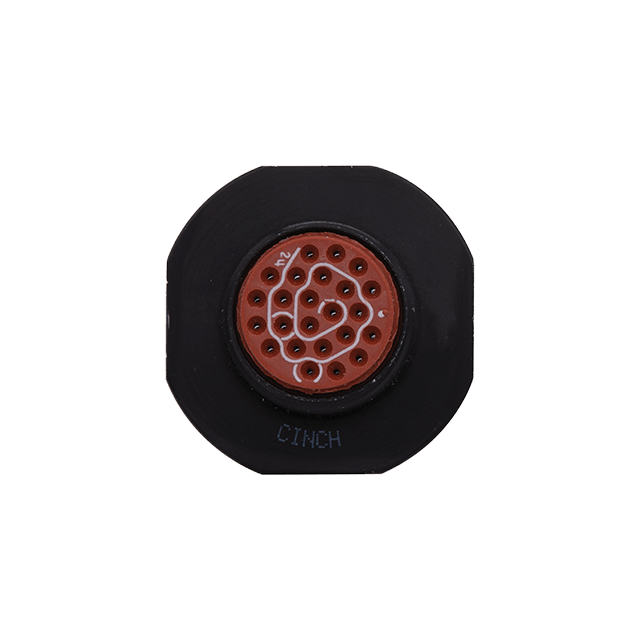
- Mil circular connectors provide ruggedized, environmentally sealed connections for outdoor mounts and enclosures, where the hardware is exposed to weather and continuous movement.
- Optical connectors provide low-loss fiber interfaces between the amplifier, the modem, and the DSP, where minimizing signal loss is critical.
Across all three connector types, OGS designers require connectors that meet Mil-Spec durability standards without adding size, weight, or signal loss to the system.
Optical Ground Station Market Timing: Why Now?
Most optical ground stations currently exist as prototypes rather than production systems, which makes the present stage an important time to engage.
An Early-Stage Market with Open Standards
The optical ground station market remains at an early stage. Systems are in design and early deployment, and the standards that will govern them have not yet been finalized. Manufacturers are nonetheless already producing telescopes, adaptive optics systems, modems, and turnkey ground terminals. This combination of established suppliers and open standards creates a green-field opportunity.
Early Adopters Are Setting the Designs
Early adopters are establishing the first designs now, and connector selections are made during this design stage. Once a connector has been designed into a qualified system, it typically remains in place as that system moves into production.
The Future of Satellite Ground Stations Is Hybrid
The transition to optical ground stations is already underway, but optical technology will be added to existing RF infrastructure rather than replacing it. Hybrid stations that combine the two will be the most common design in the near term. Commercial space currently leads demand, with defense applications for GEO relay expected to follow.
Optical technology offers significant advantages in bandwidth, security, and SWaP. It also requires a new class of hardware designed for precision, ruggedness, and signal integrity, from the ATP mount to the DSP. Cinch's Micro-D, Mil circular, and optical connector lines are designed to meet these requirements. Explore Cinch's extensive portfolio of mission ready defense solutions.
 Optical Technology Connectors
 Optical Technology Transceivers
 Mil-Spec Qualified Circular Connectors
 Space-Screened Micro-D Connectors